

Fortress of the Night: Your Authoritative Guide to the Prophetic Evening Adhkar

As the day’s activities fade and the quiet of the night descends, our minds are often filled with the worries of the day past and the anxieties of the day to come. How do we transform this vulnerability into a state of profound peace and divine protection?
The answer lies in a beautiful nightly ritual taught by our Prophet Muhammad (ﷺ): the Evening Adhkar (Adhkar al-Masa’).
This is not just a routine; it is the act of building a spiritual fortress around yourself before you sleep. These prophetic supplications are your shield against Shaytan, your source of tranquility, and your means of ending your day upon the remembrance of Allah.
Unlike simple lists, this guide is a complete reference. Here, you will find the authentic Adhkar with their sources, their immense virtues, their deeper meanings, and the proper etiquette for reciting them. Our goal is to empower you to make this blessed practice an unbreakable pillar of your nightly routine.
The Fortress of the Night: Why Evening Dhikr is Essential
Just as the morning Adhkar prepare us for the day ahead, the evening Adhkar serve as our spiritual conclusion, providing a powerful transition from the worldly to the sacred as we prepare for rest. The night holds a special place in Islam, and remembering Allah during this time has profound significance.
1. A Garment of Tranquility and a Time for Reflection
Allah Himself describes the night as a time for rest and peace. He says in the Qur’an:
وَهُوَ الَّذِي جَعَلَ لَكُمُ اللَّيْلَ لِبَاسًا وَالنَّوْمَ سُبَاتًا
“And it is He who has made the night for you as a clothing and sleep as a rest…”
Source: (Qur’an 25:47)
By engaging in dhikr, you align yourself with the divine purpose of the night, wrapping yourself in a garment of tranquility before sleep.
2. A Divine Shield Against All Evils of the Night
The night can be a time of vulnerability, both physically and spiritually. The evening Adhkar act as a divine fortress, protecting the believer from nightmares, the whispers of Shaytan, and any unseen harm until the morning.
The Prophet (ﷺ) provided us with specific supplications, like Ayat al-Kursi, which place a guard from Allah over us throughout the night.
3. Ending Your Day Upon Goodness and Tawhid
Our final actions of the day carry immense weight. The state in which you fall asleep is crucial, as sleep is considered a “minor death.” By making your last words the remembrance of Allah, you entrust your soul to Him in the best possible state.
This is why the Prophet (ﷺ) taught us duas that are powerful affirmations of Tawhid and trust in Allah, ensuring our day ends as it began: in submission to our Creator.
4. The Two Verses That Are “Sufficient”
One of the greatest virtues of night-time remembrance is tied to the last two verses of Surah Al-Baqarah. The Prophet (ﷺ) said:
مَنْ قَرَأَ بِالْآيَتَيْنِ مِنْ آخِرِ سُورَةِ الْبَقَرَةِ فِي لَيْلَةٍ كَفَتَاهُ
“Whoever recites the last two verses of Surah Al-Baqarah at night, they will be sufficient for him.”
Source: (Sahih al-Bukhari & Sahih Muslim)
Scholars have explained that “sufficient” can mean they are sufficient as a protection from all evil, or that they suffice him in place of praying the entire night. This highlights the incredible blessing of this specific act.
The Complete Evening Adhkar Library
This library contains the authentic evening remembrances (Adhkar al-Masa’) as taught by the Prophet Muhammad (ﷺ). Each one is presented with its source, virtue, and meaning, to help you conclude your day with peace and protection.
1. Ayat al-Kursi (The Verse of the Throne)
When to Recite: Recite one time in the evening or before sleep.
Simple Benefit: Reciting this verse provides you with a guardian from Allah who will protect you throughout the night until you wake up.
اللَّهُ لَا إِلَٰهَ إِلَّا هُوَ الْحَيُّ الْقَيُّومُ ۚ … وَهُوَ الْعَلِيُّ الْعَظِيمُ
Allāhu lā ilāha illā huwal-ḥayyul-qayyūm… wa huwal-‘aliyyul-‘aẓīm.
Full Translation: “Allah – there is no deity except Him, the Ever-Living, the Self-Sustaining…” (Qur’an 2:255)
Source & Virtue: Narrated by Abu Hurairah (RA), the Prophet (ﷺ) confirmed that whoever recites Ayat al-Kursi when they go to bed, a guardian from Allah will remain with them, and no devil will approach them until morning. (Sahih al-Bukhari).
2. The Last Two Verses of Surah Al-Baqarah
When to Recite: Recite one time during the night.
Simple Benefit: These two verses are so powerful that they are completely sufficient for your protection and well-being for the entire night.
آمَنَ الرَّسُولُ بِمَا أُنْزِلَ إِلَيْهِ مِنْ رَبِّهِ وَالْمُؤْمِنُونَ ۚ كُلٌّ آمَنَ بِاللَّهِ وَمَلَائِكَتِهِ وَكُتُبِهِ وَرُسُلِهِ… غُفْرَانَكَ رَبَّنَا وَإِلَيْكَ الْمَصِيرُ
Āmanar-rasūlu bimā unzila ilayhi mir-rabbihi wal-mu’minūn… ghufrānaka rabbanā wa ilaykal-maṣīr.
Full Translation: “The Messenger has believed in what was revealed to him from his Lord, and [so have] the believers… [They say], ‘We seek Your forgiveness, our Lord, and to You is the [final] destination.'” (Qur’an 2:285-286)
Source & Virtue: Recorded in Sahih al-Bukhari and Sahih Muslim. The Prophet (ﷺ) said: “Whoever recites the last two verses of Surah Al-Baqarah at night, they will be sufficient for him.”
3. The Three Quls (with the Prophetic Action)
When to Recite: Recite three times each before sleeping.
Simple Benefit: This is the Prophet’s own practice for nightly protection from sickness and evil.
The Sunnah is to cup your hands together, recite the three Surahs into them, and then blow lightly into your hands. You then wipe your hands over whatever you can of your body, starting with your head, face, and the front of your body. This is repeated three times.
Surah Al-Ikhlas: Qul huwa Allāhu aḥad…
Surah Al-Falaq: Qul a‘ūdhu birabbil-falaq…
Surah An-Nas: Qul a‘ūdhu birabbin-nās…
Source & Virtue: Narrated by ‘Aishah (RA), who described that this was the consistent practice of the Prophet (ﷺ) every night before he went to sleep. (Sahih al-Bukhari).
4. The Declaration of Sovereignty (Evening Version)
When to Recite: Recite one time in the evening.
Simple Benefit: A comprehensive affirmation of Allah’s dominion and a plea for the good of the night.
أَمْسَيْنَا وَأَمْسَى الْمُلْكُ لِلَّهِ، وَالْحَمْدُ لِلَّهِ، لَا إِلَهَ إِلَّا اللَّهُ وَحْدَهُ لَا شَرِيكَ لَهُ، لَهُ الْمُلْكُ وَلَهُ الْحَمْدُ وَهُوَ عَلَى كُلِّ شَيْءٍ قَدِيرٌ. رَبِّ أَسْأَلُكَ خَيْرَ مَا فِي هَذِهِ اللَّيْلَةِ وَخَيْرَ مَا بَعْدَهَا، وَأَعُوذُ بِكَ مِنْ شَرِّ مَا فِي هَذِهِ اللَّيْلَةِ وَشَرِّ مَا بَعْدَهَا. رَبِّ أَعُوذُ بِكَ مِنَ الْكَسَلِ وَسُوءِ الْكِبَرِ، رَبِّ أَعُوذُ بِكَ مِنْ عَذَابٍ فِي النَّارِ وَعَذَابٍ فِي الْقَبْرِ
Amsayna wa amsal-mulku lillah, wal-hamdulillah, la ilaha ill-Allah wahdahu la sharika lah, lahul-mulku wa lahul-hamd, wa huwa ‘ala kulli shay’in qadir. Rabbi as’aluka khayra ma fi hadhihil-laylati wa khayra ma ba‘daha, wa a‘udhu bika min sharri ma fi hadhihil-laylati wa sharri ma ba‘daha. Rabbi a‘udhu bika minal-kasali wa su’il-kibar, Rabbi a‘udhu bika min ‘adhabin fin-nari wa ‘adhabin fil-qabr.
Full Translation: “We have reached the evening and at this very time all sovereignty belongs to Allah, and all praise is for Allah. There is no god but Allah, alone, without partner. His is the sovereignty and His is the praise, and He is over all things competent. My Lord, I ask You for the good of this night and the good of what follows it, and I seek refuge in You from the evil of this night and the evil of what follows it. My Lord, I seek refuge in You from laziness and the hardships of old age. My Lord, I seek refuge in You from torment in the Fire and torment in the grave.”
Source & Virtue: Recorded in Sahih Muslim. The Prophet (ﷺ) would recite this every evening, adapting the words from the morning version.
5. The Dua of Embracing the Evening
When to Recite: Recite one time.
Simple Benefit: Acknowledging Allah’s absolute power over the transition from day to night, and life to death.
اللَّهُمَّ بِكَ أَمْسَيْنَا، وَبِكَ أَصْبَحْنَا، وَبِكَ نَحْيَا، وَبِكَ نَمُوتُ، وَإِلَيْكَ الْمَصِيرُ
Allahumma bika amsayna, wa bika asbahna, wa bika nahya, wa bika namut, wa ilaykal-masir.
Full Translation: “O Allah, by You we reach the evening and by You we reach the morning, by You we live and by You we die, and to You is the final return.”
Source & Virtue: Recorded in Jami` at-Tirmidhi. Note the slight change from the morning version, where “An-Nushur” (the resurrection) is used for the morning, and “Al-Masir” (the final return) is used for the evening, reflecting the end of the day.
6. The Master of Forgiveness (Evening Recitation)
When to Recite: Recite one time in the evening with full certainty.
Simple Benefit: Saying this with true faith in the evening provides a path to Paradise if one passes away during the night.
اللَّهُمَّ أَنْتَ رَبِّ لَا إِلَهَ إِلَّا أَنْتَ، خَلَقْتَنِي وَأَنَا عَبْدُكَ…
Allahumma Anta Rabbi la ilaha illa Anta, khalaqtani wa ana ‘abduka…
Full Translation: “O Allah, You are my Lord, there is no god but You. You created me and I am Your slave…”
Source & Virtue: Recorded in Sahih al-Bukhari. The Prophet (ﷺ) said: “…whoever says it during the night with firm faith in it and dies before the morning, he will be from the people of Paradise.”
7. The Ultimate Shield Against Harm
When to Recite: Recite three times in the evening.
Simple Benefit: A powerful protection from any sudden calamity or harm throughout the night.
بِسْمِ اللَّهِ الَّذِي لَا يَضُرُّ مَعَ اسْمِهِ شَيْءٌ فِي الْأَرْضِ وَلَا فِي السَّمَاءِ وَهُوَ السَّمِيعُ الْعَلِيمُ
Bismillahilladhi la yadurru ma‘asmihi shay’un fil-ardi wa la fis-sama’i wa Huwas-Sami‘ul-‘Alim.
Full Translation: “In the Name of Allah, with Whose Name nothing on the earth or in the heavens can cause harm, and He is the All-Hearing, the All-Knowing.”
Source & Virtue: Recorded in Jami` at-Tirmidhi. The Prophet (ﷺ) assured that whoever recites it three times in the evening will not be afflicted by any sudden harm until the morning.
8. The Tasbih of Fatimah (Before Sleep)
When to Recite: Recite once right before sleeping.
Simple Benefit: The Prophet (ﷺ) taught this to his daughter Fatimah (RA) as something better than a servant, providing strength and relieving the burdens of the day.
تُسَبِّحُونَ وَتَحْمَدُونَ وَتُكَبِّرُونَ عِنْدَ كُلِّ صَلَاةٍ ثَلَاثًا وَثَلَاثِينَ، وَإِذَا أَخَذْتُمْ مَضَاجِعَكُمْ، تُسَبِّحُونَ أَرْبَعًا وَثَلَاثِينَ، وَتَحْمَدُونَ ثَلَاثًا وَثَلَاثِينَ، وَتُكَبِّرُونَ ثَلَاثًا وَثَلَاثِينَ
SubhanAllah (33 times)
Alhamdulillah (33 times)
Allahu Akbar (34 times)Full Translation: “Glorify Allah (by saying SubhanAllah) 33 times, Praise Allah (by saying Alhamdulillah) 33 times, and Magnify Allah (by saying Allahu Akbar) 34 times.”
Source & Virtue: Recorded in Sahih Muslim. This is a powerful form of remembrance to end your day with, giving you physical and spiritual strength for the next day.
9. The Dua When Lying Down to Sleep
When to Recite: Recite once as you lie down in bed.
Simple Benefit: Entrusting your soul to Allah as you sleep and asking for a blessed awakening.
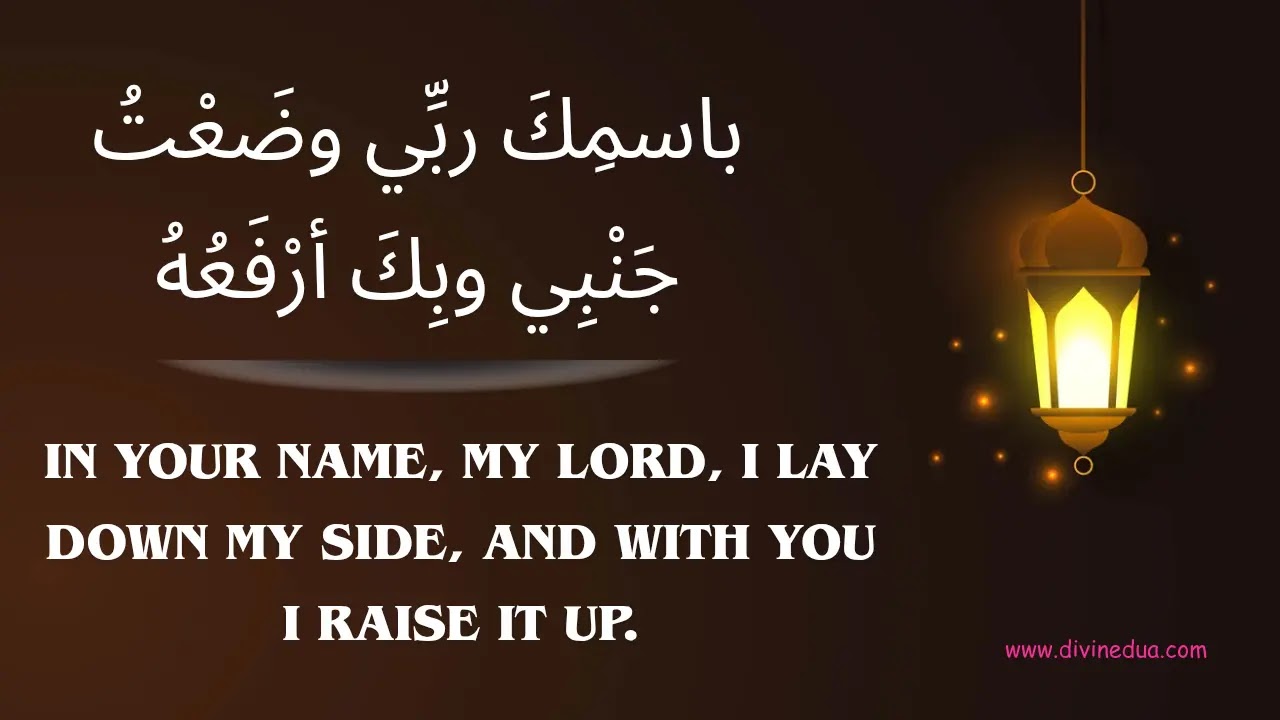
بِاسْمِكَ رَبِّ وَضَعْتُ جَنْبِي، وَبِكَ أَرْفَعُهُ، فَإِنْ أَمْسَكْتَ نَفْسِي فَارْحَمْهَا، وَإِنْ أَرْسَلْتَهَا فَاحْفَظْهَا بِمَا تَحْفَظُ بِهِ عِبَادَكَ الصَّالِحِينَ
Bismika Rabbi wada’tu janbi, wa bika arfa’uh, fa in amsakta nafsi farhamha, wa in arsaltaha fahfazha bima tahfazu bihi ‘ibadakas-salihin.
Full Translation: “In Your name my Lord, I lie down, and in Your name I rise. If You take my soul, then have mercy on it, and if You send it back, then protect it as You protect Your righteous slaves.”
Source & Virtue: Recorded in Sahih al-Bukhari and Sahih Muslim. This is a fundamental dua for submitting your state of sleep to the will and protection of Allah.
10. The Comprehensive Dua for Well-being (‘Afiyah)
When to Recite: Recite one time in the evening.
Simple Benefit: A profound plea for safety and well-being in your religion, family, wealth, and worldly affairs.
اللَّهُمَّ إِنِّي أَسْأَلُكَ الْعَافِيَةَ فِي الدُّنْيَا وَالْآخِرَةِ، اللَّهُمَّ إِنِّي أَسْأَلُكَ الْعَفْوَ وَالْعَافِيَةَ فِي دِينِي وَدُنْيَايَ وَأَهْلِي وَمَالِي…
Allahumma inni as’alukal-‘afiyata fid-dunya wal-akhirah…
Full Translation: “O Allah, I ask You for well-being in this world and the Hereafter. O Allah, I ask You for forgiveness and well-being in my religion, my worldly affairs, my family and my wealth…”
Source & Virtue: Recorded in Sunan Abi Dawood. The Prophet (ﷺ) never failed to recite this dua every morning and evening.
11. Seeking Refuge from the Punishment of the Day of Judgment
When to Recite: Recite three times before sleep.
Simple Benefit: A humble supplication for safety from the torment of the Hereafter.
اللَّهُمَّ قِنِي عَذَابَكَ يَوْمَ تَبْعَثُ عِبَادَكَ
Allahumma qini ‘adhabaka yawma tab’athu ‘ibadak.
Full Translation: “O Allah, save me from Your punishment on the Day You resurrect Your slaves.”
Source & Virtue: Recorded in Jami` at-Tirmidhi. It is reported that the Prophet (ﷺ) would place his right hand under his cheek when he was about to sleep and recite this.
More Than Just Words: The Prophetic Etiquette of Preparing for Sleep

The evening Adhkar are most effective when coupled with the physical actions and etiquette (adab) taught by the Prophet Muhammad (ﷺ). These practices prepare your body and soul for a blessed and protected sleep.
1. Sleeping in a State of Purity (Wudu)
One of the most emphasized acts is to perform wudu (ablution) before going to bed, even if you are not going to pray. This ensures you are in a state of spiritual and physical purity as your soul is entrusted to Allah during sleep.
The Prophetic Virtue: The Prophet (ﷺ) said, “Purify these bodies, and Allah will purify you. Whenever a slave spends his night in a state of purification, an angel spends his night within his (slave’s) garment, and he does not turn over during the night except that he [the angel] says: ‘O Allah, forgive Your slave, for he spent his night in a state of purification.'” (At-Tabarani, Graded Hasan)
2. Dusting the Bed Before Lying Down
Before getting into bed, the Sunnah is to dust it off three times with the edge of your lower garment (izar) or a cloth.
The Prophetic Virtue: The Prophet (ﷺ) said, “When any one of you goes to bed, he should take hold of the hem of his lower garment and dust his bed with it three times, and say: ‘Bismillah’. For he does not know what has come onto it after he left it.” (Sahih Muslim).
This is a simple act of hygiene and seeking protection.
3. Lying on Your Right Side
The Prophet (ﷺ) would always lie on his right side, especially at the beginning of his sleep. It is also recommended to face the Qiblah if possible.
The Prophetic Practice: He instructed al-Bara’ ibn ‘Azib (RA), “When you go to your bed, perform ablution as you would for prayer, then lie down on your right side…” (Sahih al-Bukhari).
4. Placing the Right Hand Under the Right Cheek
A beautiful and simple habit of the Prophet (ﷺ) was to place his right hand under his right cheek as he lay on his right side. This is a peaceful and beloved posture to imitate.
5. Making Dhikr Your Final Act
The ultimate etiquette is to ensure that the remembrance of Allah is the very last thing you do before you fall asleep. After settling into bed, perform the Adhkar we have detailed in the library, concluding with the supplications specifically for lying down.
This seals your day with the best of deeds and guarantees that your soul departs for its “minor death” upon Tawhid and trust in Allah.
The Fruits of a Blessed Night: Tangible Benefits of Evening Adhkar
Making the evening Adhkar a consistent, non-negotiable part of your nightly routine is one of the best investments you can make for your spiritual, mental, and physical well-being. The benefits go far beyond the moment of recitation.
Here are some of the fruits you can hope to harvest:
- A Fortress of Divine Protection: This is the most immediate benefit. By reciting the specified duas, you are literally building a fortress of light around yourself, gaining a dedicated guardian from Allah who shields you from Shaytan, nightmares, and all unseen harm until you wake.
- A Deeper, More Tranquil Sleep: The act of dhikr is the ultimate source of peace for the heart. By replacing the day’s anxieties and worries with the remembrance of Allah, you calm your mind and soul, leading to a more peaceful and restorative sleep.
- Waking Up for Fajr with Ease: When you end your day in a state of purity and connection to Allah, your soul remains inclined towards worship. Many find that a consistent evening Adhkar routine makes waking up for Fajr prayer significantly easier and more natural.
- Strengthened Faith and Trust (Tawakkul): Entrusting your soul to Allah every night builds a powerful habit of reliance on Him. This daily practice strengthens your Iman and deepens your understanding that He is in control of all affairs, both when you are awake and when you are asleep.
- A Clean Slate of Forgiveness: By sincerely reciting supplications like Sayyid al-Istighfar, you go to sleep with the hope of Allah’s complete forgiveness. This provides an incredible sense of spiritual lightness and the chance to start the next day fresh and unburdened by sin.
This blessed state makes it easier to not only wake up for Fajr but to continue the morning with other beautiful acts of worship like Salat al-Duha.
Your Questions Answered: A Practical FAQ
Here are some concise answers to common questions about the evening Adhkar.
1. What is the correct time for the Evening Adhkar?
The time for the evening Adhkar (Adhkar al-Masa’) begins after the Asr prayer and extends until the night begins (around Maghrib/Isha).
However, there is a specific subset of these remembrances that are recited right before you get into bed to sleep, such as Ayat al-Kursi, the last two verses of Surah Al-Baqarah, and the Three Quls. The best practice is to recite the general evening Adhkar after Asr, and the pre-sleep Adhkar as the very last thing you do before sleeping.
2. What if I fall asleep before I can finish all the Adhkar?
You should do your best to recite what you can, but there is no sin on you if you are overcome by sleep. Your intention to complete them is rewarded, by the will of Allah.
Focus on consistency with the most important ones first, like Ayat al-Kursi and the Three Quls. Even completing these few is a great act of worship that carries immense blessings and protection.
3. Are the morning and evening Adhkar the same?
Many of them are the same but with a slight change in wording. For a complete reference on the morning supplications, you can read our Authoritative Guide to Dua after Fajr.
4. Can I read the Adhkar from my phone or a book?
Yes, absolutely. It is perfectly permissible to read the Adhkar from a phone, an app, or a book if you have not memorized them. The goal is the remembrance of Allah, and using a tool to help you is encouraged.
The most important factor is to have a present heart (hudhur al-qalb) and to reflect on the meanings as you recite them, regardless of the medium you use.
Seal Your Day with Peace and Protection
As darkness falls and we retreat from the world, the evening Adhkar offer us a profound opportunity to turn inwards and reconnect with our Creator. We have explored how these prophetic words are not just a routine, but a shield, a source of tranquility, and a means of entrusting our very souls to Allah’s care.
You now have a complete library of these spiritual treasures. Do not feel that you must recite them all at once. The Prophet (ﷺ) taught us that the most beloved deeds to Allah are those that are done consistently, even if they are few.
Start tonight. Choose just one or two, like Ayat al-Kursi and the Three Quls. Let the remembrance of Allah be the final words your tongue utters and the last thought your heart holds before you sleep. Make it your sacred ritual to seal your day upon goodness.
By doing so, you transform your sleep from a state of heedlessness into a continuous act of worship, ensuring you are protected in this world and rewarded in the next.
Entrust your night to Allah, and He will grant you a peaceful dawn.