
What to Say in Janazah Prayer? Step-by-Step Guide with Transliteration
Salat al-Janazah (Funeral Prayer) is a communal obligation (Fard Kifayah) in Islam. It is a profound act of worship where we gather not to bow or prostrate, but to stand and plead with Allah for forgiveness and mercy upon the deceased.
Many Muslims feel anxious before the Janazah prayer because they might have forgotten exactly what to say or when to say it. This guide is designed to help you perform the prayer confidently with the correct Duas and pronunciation.
⚠️ In a hurry? If you are currently at the funeral and need to know what to say immediately, Click here to jump to the Step-by-Step Guide.
Prerequisites: Before You Start
Before joining the rows for the funeral prayer, ensure you meet these simple requirements. Unlike the daily prayers, Salat al-Janazah has specific conditions:
- Wudu (Ablution): You must be in a state of purity.
- Facing the Qiblah: Stand facing the direction of the Kaaba.
- Standing Only: There is no Ruku (bowing) and no Sujood (prostration) in this prayer. It is performed entirely while standing.
- Intention (Niyyah): Make the intention in your heart to pray for the deceased seeking the pleasure of Allah.
How to Perform Salat al-Janazah (The 4 Takbirs)
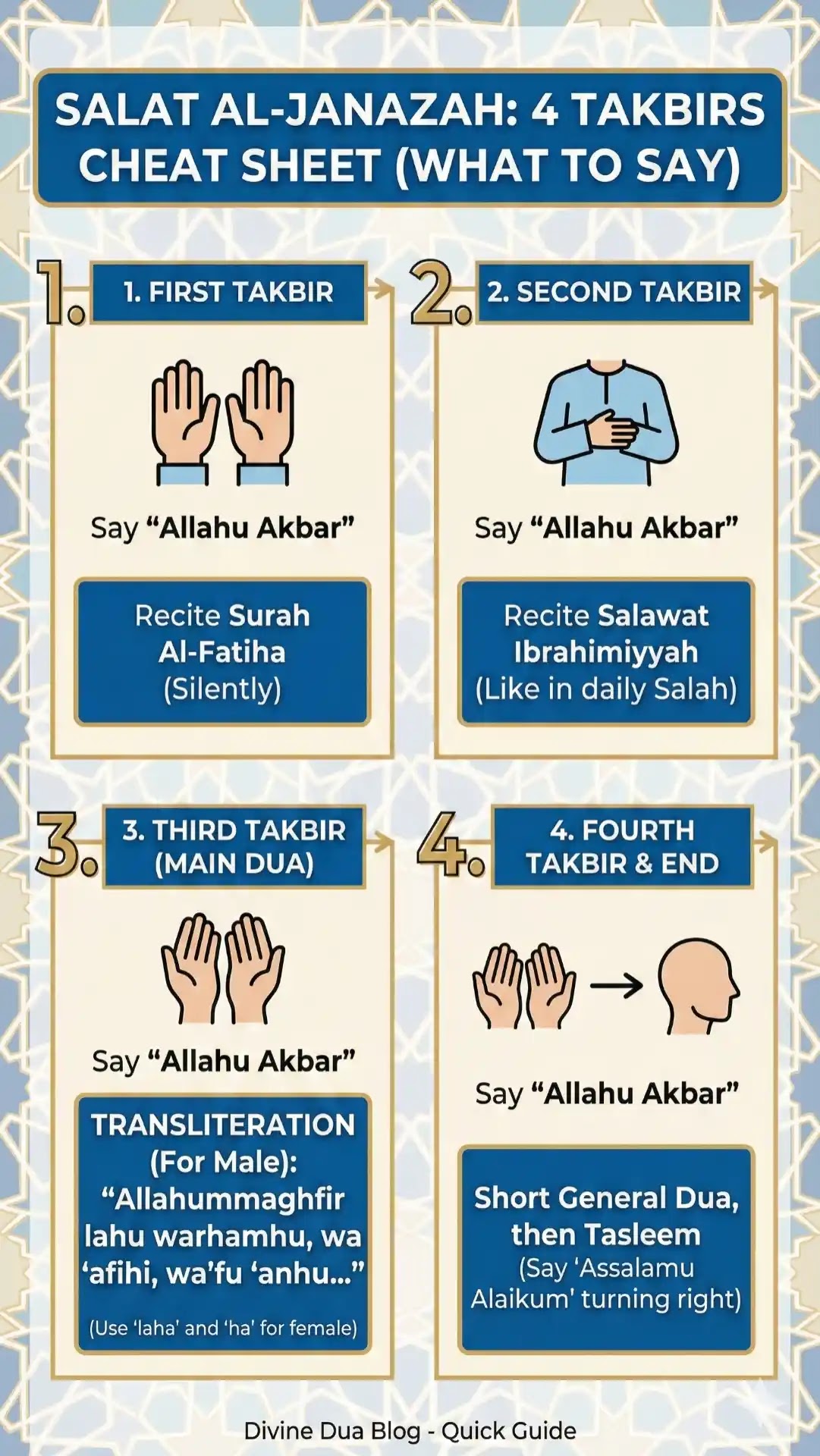
💡 Tap image to enlarge or save it for quick revision.
The funeral prayer consists of 4 Takbirs (saying “Allahu Akbar” four times). There is no Adhan and no Iqamah. Here is exactly what you need to recite after each Takbir.
1. The First Takbir
The Imam says “Allahu Akbar”. Raise your hands to your ear level and then fold them over your chest (Right hand over Left), just as you do in your daily prayers.
After the first Takbir, recite Surah Al-Fatiha silently:
Arabic:
بِسْمِ ٱللَّهِ ٱلرَّحْمَـٰنِ ٱلرَّحِيمِ
ٱلْحَمْدُ لِلَّهِ رَبِّ ٱلْعَـٰلَمِينَ
ٱلرَّحْمَـٰنِ ٱلرَّحِيمِ
مَـٰلِكِ يَوْمِ ٱلدِّينِ
إِيَّاكَ نَعْبُدُ وَإِيَّاكَ نَسْتَعِينُ
ٱهْدِنَا ٱلصِّرَٰطَ ٱلْمُسْتَقِيمَ
صِرَٰطَ ٱلَّذِينَ أَنْعَمْتَ عَلَيْهِمْ غَيْرِ ٱلْمَغْضُوبِ عَلَيْهِمْ وَلَا ٱلضَّالِّينَTransliteration:
Bismillahi r-Rahmani r-Rahim. Al-hamdu lillahi rabbi l-alamin. Ar-rahmani r-rahim. Maliki yawmi d-din. Iyyaka na’budu wa iyyaka nasta’in. Ihdina s-sirata l-mustaqim. Sirata lladhina an’amta ‘alayhim ghayril maghdubi ‘alayhim walad dallin.
2. The Second Takbir
The Imam says “Allahu Akbar” for the second time. Do not raise your hands; keep them folded on your chest.
After the second Takbir, recite the Salawat (Salat Ibrahimiyyah):
This is the same prayer you recite in the Tashahhud of your daily Salah.
Arabic:
اللَّهُمَّ صَلِّ عَلَى مُحَمَّدٍ وَعَلَى آلِ مُحَمَّدٍ كَمَا صَلَّيْتَ عَلَى إِبْرَاهِيمَ وَعَلَى آلِ إِبْرَاهِيمَ إِنَّكَ حَمِيدٌ مَجِيدٌ . اللَّهُمَّ بَارِكْ عَلَى مُحَمَّدٍ وَعَلَى آلِ مُحَمَّدٍ كَمَا بَارَكْتَ عَلَى إِبْرَاهِيمَ وَعَلَى آلِ إِبْرَاهِيمَ إِنَّكَ حَمِيدٌ مَجِيدٌTransliteration:
Allahumma salli ‘ala Muhammadin wa ‘ala ali Muhammad, kama sallayta ‘ala Ibrahima wa ‘ala ali Ibrahim, innaka Hamidun Majid. Allahumma barik ‘ala Muhammadin wa ‘ala ali Muhammad, kama barakta ‘ala Ibrahima wa ‘ala ali Ibrahim, innaka Hamidun Majid.Meaning:
O Allah, send prayers upon Muhammad and upon the family of Muhammad, as You sent prayers upon Ibrahim and upon the family of Ibrahim; You are indeed Worthy of Praise, Full of Glory. O Allah, send blessings upon Muhammad and upon the family of Muhammad as You sent blessings upon Ibrahim and upon the family of Ibrahim; You are indeed Worthy of Praise, Full of Glory.
3. The Third Takbir (The Main Dua)
The Imam says “Allahu Akbar” for the third time. This is the core of the funeral prayer where you make sincere Dua for the deceased.
The pronoun in the Dua changes depending on whether the deceased is a male or a female. Below is the standard authentic Dua narrated from the Prophet (PBUH) [Source].
A. If the Deceased is an Adult Male
Recite the following (using the masculine pronoun “Lahu”):
Arabic:
اللَّهُمَّ اغْفِرْ لَهُ وَارْحَمْهُ، وَعَافِهِ، وَاعْفُ عَنْهُ، وَأَكْرِمْ نُزُلَهُ، وَوَسِّعْ مُدْخَلَهُ، وَاغْسِلْهُ بِالْمَاءِ وَالثَّلْجِ وَالْبَرَدِ، وَنَقِّهِ مِنَ الْخَطَايَا كَمَا نَقَّيْتَ الثَّوْبَ الأَبْيَضَ مِنَ الدَّنَسِTransliteration:
Allahummaghfir lahu warhamhu, wa ‘afihi, wa’fu ‘anhu, wa akrim nuzulahu, wa wassi’ mudkhalahu, waghsilhu bil-ma’i wath-thalji wal-barad, wa naqqihi minal-khataya kama naqqayta-th-thawbal-abyada minad-danas.Meaning:
O Allah, forgive him and have mercy on him, keep him safe and sound and forgive him, honor the place where he settles and make his entrance wide; wash him with water and snow and hail, and cleanse him of sin as a white garment is cleansed of dirt.
There are many other beautiful supplications you can recite. For a longer list, check out our article on 10 Powerful Supplications for the Dead Person.
B. If the Deceased is an Adult Female
You use the same Dua but change the pronoun “Lahu” (Him) to “Laha” (Her), and “Hu” to “Ha”.
Arabic:
اللَّهُمَّ اغْفِرْ لَهَا وَارْحَمْهَا، وَعَافِهَا، وَاعْفُ عَنْهَا…Transliteration:
Allahummaghfir laha warhamha, wa ‘afiha, wa’fu ‘anha… (continue the same way).
C. Short Version (Easy to Memorize)
If you find the long Dua difficult to memorize, or if the Imam recites quickly, it is sufficient to say the core part:
Transliteration:
Allahummaghfir lahu warhamhu (For Male)
Allahummaghfir laha warhamha (For Female)Meaning:
O Allah, forgive [him/her] and have mercy on [him/her].
4. The Fourth Takbir and Tasleem
The Imam says “Allahu Akbar” for the fourth and final time. After this Takbir, there is usually a brief pause.
What to say?
Technically, you can remain silent or recite a general Dua for all Muslims. A common and easy Dua to recite here is:
Transliteration:
Rabbana atina fid-dunya hasanah, wa fil-akhirati hasanah, wa qina ‘adhaban-nar.Meaning:
Our Lord, give us in this world [that which is] good and in the Hereafter [that which is] good and protect us from the punishment of the Fire.
Ending the Prayer (Tasleem):
The Imam will conclude the prayer by saying “Assalamu Alaikum wa Rahmatullah” while turning his head to the right.
You should follow him by saying the same and turning your head to the right. Some schools of thought perform only one Tasleem (to the right), while others perform two (right then left). Simply follow the Imam leading the prayer.
Common Mistakes to Avoid in Janazah Prayer
Even though the prayer is short, many people make unintentional mistakes due to lack of knowledge. Here are the most common ones to watch out for:
- Performing Ruku or Sujood:
This is the most critical mistake. Remember that Salat al-Janazah is performed entirely while standing. There is no bowing and no prostration. - Reciting out loud:
Unlike Eid prayers, the Janazah prayer is a silent prayer. You should move your lips and recite the Duas to yourself, not aloud. - Looking around or at the sky:
Keep your gaze lowered towards the place of your feet or the coffin, just as you would look at the place of Sujood in a regular prayer. - Raising hands for every Takbir:
While there is a difference of opinion among scholars, the majority view (Hanafi and Maliki) is that you only raise your hands for the first Takbir. However, if you follow the Shafi’i or Hanbali view and raise them, your prayer is still valid.
Frequently Asked Questions
1. What if I join the prayer late?
If you arrive while the Imam is already praying, do not wait. Say “Allahu Akbar” and join immediately. This counts as your first Takbir. Follow the Imam until he finishes. Once he says Salam, do not say Salam with him. Instead, stand up and quickly complete the missing Takbirs (reciting the minimal Duas for them) and then make Tasleem yourself.
2. Can I read the Dua from my phone?
Yes, especially if you are learning or afraid of forgetting. It is permissible to hold your phone and read the Dua text during the Janazah prayer to ensure you are praying correctly.
3. Can women perform Salat al-Janazah?
Yes, it is permissible for women to participate in the funeral prayer inside the mosque or prayer area, and they earn the same great reward (Qirat) as men.
Conclusion
Attending a funeral prayer is a reminder of our final destination. By learning what to say in Janazah prayer, you fulfill your duty towards your deceased brother or sister.
If you are praying for a deceased parent, don’t forget to read our guide on Dua and Sadaqah Jariyah for Deceased Parents.
May Allah have mercy on our deceased and grant us a good ending. Ameen.
Recommended Next Step:
After the Janazah prayer, the deceased is taken for burial. Make sure you know the proper etiquettes and what to say at the cemetery:
👉 Read: Graveyard Dua / Significance, Benefits, and Etiquette